What was St. George Like in 1820?
Population: 1325 -- 174 families on mainland and 28 families on islands
- A 1776 map of the St. George peninsula shows 6 homes on the mainland and 2 on islands
- A document dated 1788 lists 39 settlers to receive deeds from General Henry Knox. Six other settlers had other arrangements with early proprietors or Knox for land on St. George peninsula. It appears that a surge in settlers occurred after the Revolutionary War.
- Communities or villages tend to center around a church. The First Baptist Church of St. George was organized at Wiley’s Corner in 1789. In 1817, 60 people organized the Second Baptist Church of St. George, commonly known as the Ridge Church.
- Mill sites were common in the early days of St. George. As of 1820 there were – or had been – at least 7 mill sites in St. George: Watts mill, Pratt’s mill, Prince’s mill, Wheeler’s mill, Seavey’s mill, York’s mill, and one mill at Otis Point.
Villages or settlements in 1820:
- South St. George (now known as Port Clyde)
- Martinsville
- St. George
- The current village of Tenants Harbor did not come into being until the 1830s – the area was owned mostly by the Henderson family in 1820.
- A large section of the Spruce Head / Wheeler’s Bay area was settled by William Rackliff and Andrew Elwell, who had married the Gardner sisters originally from Gloucester, Mass.
- The upper part of town around what is now known as Wiley’s Corner was settled by the Kelloch, Robinson, Hall and Gilchrest families, whose roots were in the early Scotch-Irish settlers of the area.
- The middle section of town was mainly settled by more Scotch-Irish families – the Watts, Long, Fogerty and Rivers families.
- The Martinsville area has a lot of its roots in the Vickery and Martin families, some coming directly from the Marblehead, Massachusetts, area while others stopped in the Bristol, Maine area before coming here.
- The early names of Port Clyde include Wilson, Marshall, Maloney and Hupper. These families came from settlements from the west – Harpswell, Boothbay and New Hampshire.
Outline for March 14, 2020, Maine Bicentennial Birthday Program

Books on St. George History
Local Books
- Cemetery Inscriptions and Burial Sites of St. George, Maine and the Nearby Islands - by Steven E Sullivan & Robert L Welsch
- Coaster Days-Shipping in the Town of St. George, Maine - by Roy E Meservey
- Eureka Lodge at St. George, Maine, History of - by William S Codman (1871)
- Eureka Lodge at St. George, Maine, History of (1909) - by Elmer E Allen
- First Baptist Church of St. George, Maine 1789-1989 published on the Occasion of the 200th Anniversary
- Fish, Ships and Quarry Chips 1856-1981 (History of Eureka Lodge No 84, AF & AM) - by Wallace M Gage
- Mayflower Descendants of St. George, Maine through Joshua and Keturah Hopkins Smalley - by Albert J Smalley
- Nathan F Hart an Innocent Man in a Felon's Cell - by Alvin R Dunton
- Soldiers and Sailors of Lower St. Georges, Maine in the Revolution - by Frank Burton Miller
- St. George Chronicles containing an Historical Sketch from 1605 to 1892
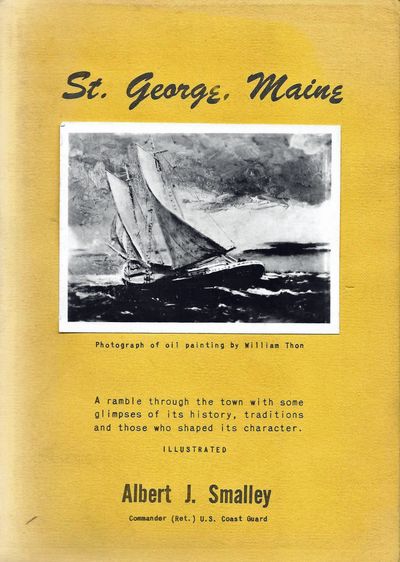
- St. George, History of - by Albert J Smalley
- St. George, Vital Records of - Maine Genealogical Society Special Publication No 43 complied by Marlene A Groves
- The St. George Peninsula - Images of America - by Tammy L Willey
- The Voyage of Archangell James Rosier's Account of the Waymouth Voyage of 1605 A True Relation - Annotated by David C Morey
- The Lobster Coast - Colin Woodard, Author
Books of Regional Interest, including St. George
- Annals of the Town of Warren, in Knox County, Maine, with the Early History of St. George's, Broad Bay and the Neighboring Settlements on the Waldo Patent - by Cyrus Eaton
- Hathorn / Harthorn, The Ancestors and Descendants of William Hathorn of Cushing, Maine - complied by Laura W Cliff, Warren F Clark & Wayne A Harthorn
- Islands of the Mid-Maine Coast [Blue Hill and Penobscot Bays] - by Charles B McLean
- Islands of the Mid-Maine Coast [Volume III - Muscongus Bay and Monhegan Island] - by Charles B McLean
- Islands of the Mid-Maine Coast [Volume IV - Pemaquid Point to the Kennebec River] - by Charles B McLean
- Records of the Lower St. Georges and Cushing, Maine 1605-1897 - transcribed and edited by Ruth J Aiken
- The Old Maps of Lincoln County, Maine in 1857
- Thomaston, Rockland and South Thomaston, Maine, from their First Exploration, AD 1605; with Family Genealogies - by Cyrus Eaton
- Vital Records of Cushing, Maine, to the Year 1940, including Town Cemetery Inscriptions - Maine Genealogical Society Special Publication No 75 - complied and edited by Marlene A Groves and Steven E Sullivan
- Vital Records of Rockland, Maine - Maine Genealogical Society Special Publication No 37 - edited by Marlene A Groves
More...
This is just the beginning of the list. If you have any comments or questions, or would like to add a book, please let me know. stgeorgemainehistory@gmail.com